
Ever felt like your marketing is a collection of parts that don’t quite fit together?
I’ve seen it a hundred times, a professional services firm with a slick website, an SEO freelancer working in the background, and maybe some Google Ads running because “that’s what you do.” On paper, you’re doing all the right things. But when you look at the bottom line, the math isn’t mathing. The phone isn’t ringing with the right clients, and your ROI is sitting in a ditch.
Here’s the thing: you haven’t built a marketing engine. You’ve built a monster.
At DM Digital, we call this the “Frankenstein Marketing” Trap. It’s what happens when you stitch together disconnected tactics without a unifying soul. It might have a heartbeat, but it sure as heck isn’t going to win a marathon. But here’s the good news, there is a way to stop the madness and turn those disjointed parts into a high-performance machine.
Ready to transform? Let’s dive in.
The Anatomy of a Marketing Monster

Frankenstein Marketing occurs when businesses assemble campaigns from disconnected pieces. You hire one agency for SEO, another for social media, and maybe a “web guy” who handles updates. Each of these people is working in a vacuum.
In my experience, this is the number one reason why growth marketing for professional services fails. You’ve got an SEO strategy targeting one set of keywords, while your Google Ads are chasing a completely different demographic. Your website looks professional, but it’s not built to convert the traffic your ads are bringing in.
It’s a mess.
When your brand presents inconsistently across these channels, your audience notices. Inconsistency is a silent killer of trust. If your LinkedIn posts sound like a corporate robot but your blog reads like a casual coffee chat, potential clients get confused. And confused people don’t buy; they bounce.
Instead of a unified force driving conversions, you have a bunch of individual components performing “adequately” in isolation while failing the business as a whole. You’re spending money, but you aren’t building an asset.
Why Disconnected Tactics are Killing Your ROI
The biggest problem with the Frankenstein approach isn’t just that it looks ugly, it’s that it’s incredibly expensive.
I’ve worked with firms that were spending $10k a month across four different vendors. When we looked under the hood, we found they were actually bidding against themselves in search auctions and creating content that their target audience didn’t even care about. They were busy, but they weren’t growing.

Without a common strategic vision, your marketing spend becomes scattered. This dilution of effort means you never reach the critical mass needed to dominate a market. You’re essentially throwing pebbles into a dozen different ponds instead of dropping a boulder into one.
Furthermore, teams lose momentum when they don’t have a North Star. Instead of proactively driving success, your marketing becomes reactive. “Oh, we need a blog post for today,” or “Let’s try a TikTok because someone said it’s cool.” This “tactic-first” mentality keeps you on a treadmill of mediocrity. You’re moving, but you’re not getting anywhere.
Take it from me: if you’re not measuring your marketing against a unified growth strategy, you’re just guessing. And guessing is a luxury your ROI can’t afford.
Enter the Revenue Operating System (ROS)
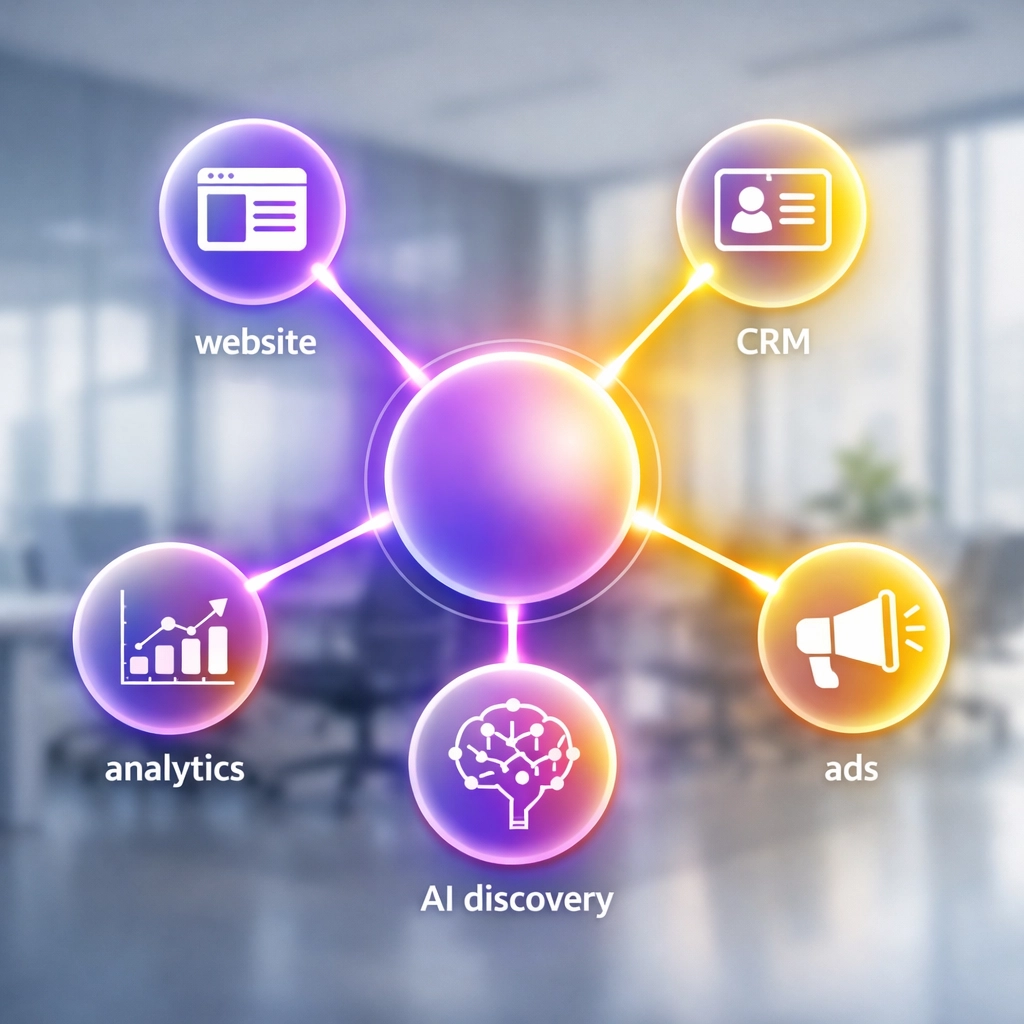
So, how do you kill the monster? You stop buying “marketing” and start building a Revenue Operating System (ROS).
Think of your marketing like a high-end computer. If you have the best processor in the world but no motherboard to connect it to the RAM or the power supply, it’s just an expensive paperweight. The Revenue Operating System is your motherboard. It’s the framework that ensures every single tactic: from your web design to your automated follow-ups: is working toward a single goal: revenue.
A true ROS isn’t just about “getting more leads.” We’ve all seen “lead gen” experts who deliver 100 leads that are actually just people looking for free advice. A Revenue Operating System focuses on pipeline velocity and sales-qualified opportunities. It’s about the entire journey from “Who are you?” to “Here is my credit card.”
When we implement an ROS for our clients at DM Digital, we look at five specific pillars:
- Foundation: Is your brand and web design ready to convert?
- Attraction: Are we using the right mix of SEO, AEO, and paid media?
- Capture: Do we have mechanisms to turn anonymous traffic into known contacts?
- Nurture: How are we staying top-of-mind until they are ready to buy?
- Expansion: How are we turning clients into advocates and increasing lifetime value?
The Conversion-First Foundation

Imagine a local law firm I worked with recently. They were spending a fortune on lead generation but their website looked like it was designed in 2004. They had plenty of traffic, but zero trust.
In a Revenue Operating System, the website isn’t just a digital brochure; it’s your hardest-working employee. Before we ever turn on the tap for ads or SEO, we ensure the foundation is built for conversion.
A marketing strategy for service businesses must prioritize the user experience. If your site is slow, hard to navigate, or lacks clear calls-to-action, every dollar you spend on marketing is being wasted. You wouldn’t invite a VIP client to an office with peeling wallpaper and no chairs, so why do it digitally?
By aligning the web design with the overall growth strategy, we ensure that when the “Attraction” phase of the ROS kicks in, the leads have a soft place to land. This is where ROI starts to climb. You aren’t just getting more traffic; you’re getting more value out of the traffic you already have.
Moving from Tactics to Systems
Here’s the thing: tactics change. Google changes its algorithm (constantly). Ad costs fluctuate. Social platforms rise and fall. If your entire marketing strategy is built on a specific tactic, you’re building on sand.
But a Revenue Operating System is adaptable. It’s a strategic blueprint that defines your brand’s foundational DNA. When a new platform emerges or an old one dies, you don’t panic. You simply plug the new tactic into the existing system.
For starters, you need to stop hiring “marketing people” to do tasks and start partnering with growth teams who understand the business of revenue. A social media manager will give you posts; a Revenue Operating System will give you a pipeline.
Pro tip: Look at your current marketing reports. If they are full of “vanity metrics” like likes, shares, or even just “clicks,” you’re likely trapped in the Frankenstein model. You need to start asking: “How much of this traffic turned into a consultation?” and “What was the cost per acquisition for our highest-value services?”
Don’t Sleep on the AI Revolution

In 2026, the stakes are even higher. With the rise of AI-driven search (AEO) and generative engines, the old “SEO-only” approach is officially dead. Your Revenue Operating System must be AI-ready. This means creating content that doesn’t just rank for keywords but actually answers the complex questions your clients are asking ChatGPT and Gemini.
This is what we call the Eureka Content Engine. It’s a part of the ROS that ensures you show up wherever your clients are looking: whether that’s a traditional Google search or an AI summary. If your tactics are disconnected, you’ll never be able to keep up with the pace of AI. But with a unified system, you can dominate the conversation.
Ready to Kill the Monster?
Marketing doesn’t have to be a scary, disjointed mess that keeps you up at night wondering where your budget went. You can move from the chaos of disconnected tactics to the clarity of a Revenue Operating System.
Instead of a Frankenstein monster that drains your resources, imagine a sleek, automated engine that builds your pipeline while you sleep. Imagine knowing that every dollar spent on SEO is being amplified by your Ads, and every visitor to your website is being nurtured toward a sale.
That’s the power of the ROS.
If you’re tired of the “Frankenstein” approach and ready to build a real system for growth, let’s talk. You can check out our About page to see how we think, or dive deeper into our Growth Strategy frameworks.
Stop building monsters. Start building revenue. It’s time to flip the switch and see what a unified system can really do for your firm. Ready to transform? Let’s get to work.