
Hey, digital marketers—picture this: You’re running an SMB, pouring heart and soul into your online presence, but when a potential customer pulls out their phone and asks Siri for “best Italian restaurant near me,” your site doesn’t even register. Ouch. I’ve seen it happen too many times—businesses with solid websites are overlooked because they’re not tuned to how people search today. Voice search is exploding, and if you’re not optimizing for it, you’re leaving money on the table. In 2025, with AI assistants brighter than ever, voice search optimization isn’t just a nice-to-have; it’s your ticket to staying visible and competitive.
Let’s break it down. Voice search upends traditional SEO. Instead of typing short keywords like “Italian restaurant NYC,” users are chatting naturally: “Hey Google, what’s the best spot for pasta in Manhattan that’s open late?” It’s conversational, question-driven, and often local. Powered by devices like Amazon Echo, Google Home, and even car infotainment systems, it’s reshaping how SMBs connect with customers. And the numbers? They’re eye-opening. Over 153.5 million Americans are using voice assistants this year, making up about 20.5% of global internet users. For SMBs, this means real opportunities—46% of voice search users search for local businesses daily, and 27% visit those locations afterward. That’s foot traffic you can’t ignore.
In this article, we’ll dive into the trends driving voice search in 2025, its specific impact on small and midsize businesses, and hands-on strategies to optimize your site. Whether you’re a solo marketer or leading a team, these tips are designed to be actionable and affordable. No need for a massive budget—tools like our Eureka Content Engine at DM Digital can automate much of this, delivering big-agency results without the hassle. Ready to make your website voice-ready? Let’s get started.
Understanding Voice Search Trends in 2025
Voice search isn’t new, but in 2025, it’s accelerating rapidly thanks to AI advancements and device proliferation. Think about it: We’ve got over 8.4 billion voice assistants worldwide—more than people on the planet. That’s not hype; it’s reality. Smart speakers are in 75% of U.S. households, and they’re not just for playing music anymore. Users are relying on them for everything from shopping to directions.
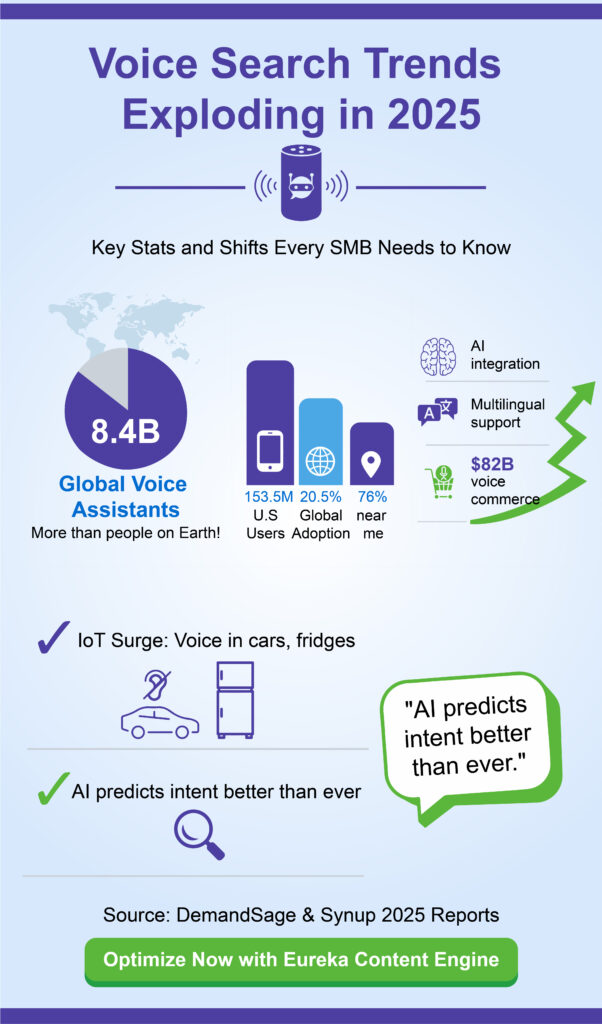
I’ve noticed in my work with SMBs that many overlook how integrated voice is becoming with everyday life. IoT devices—like fridges that reorder groceries or cars that suggest pit stops—are fueling this. Voice commerce alone is projected to hit $82 billion globally this year. As multilingual support improves, businesses can reach diverse audiences with minimal effort. AI is the secret sauce here, predicting user intent better than ever. For instance, if someone asks, “What’s the weather like for hiking tomorrow?” the assistant doesn’t just spit out temps—it suggests gear or trails.
But the significant shift? Local and mobile dominance. A whopping 76% of voice searches include “near me,” and they’re happening on the go. Mobile voice queries are surging, and results need to load fast—52% quicker than average pages, clocking in under 4.6 seconds. If your site’s sluggish, you’re out. Trends also point to more personalized experiences, with voice blending into AR and VR for immersive searches. Privacy concerns are rising, but regulations like the updated GDPR are keeping things in check.
For digital marketers targeting SMBs, this means rethinking strategies. Traditional keyword stuffing won’t cut it; it’s about natural language and context. According to DemandSage’s 2025 voice search statistics, adoption is up across all ages, with Gen Z leading at 55%. Multilingual AI is opening doors for global SMBs—think a boutique in Miami optimizing for Spanish queries to tap local tourists. And with voice in wearables like smartwatches, searches are shorter, more urgent. The takeaway? Voice search is democratizing SEO, letting nimble SMBs punch above their weight.
The Impact of Voice Search on SMBs
So, why should SMBs care? Simple: Visibility equals viability. In a world where 58% of consumers use voice search to find local info weekly, ignoring it means ceding ground to competitors. Opportunities abound—optimized sites see higher conversion rates because voice results often lead directly to action. That 27% visit rate I mentioned? It translates to real revenue for cafes, shops, and services. I’ve helped SMBs boost local traffic by 30% by optimizing for voice, such as adding conversational FAQs that capture featured snippets.
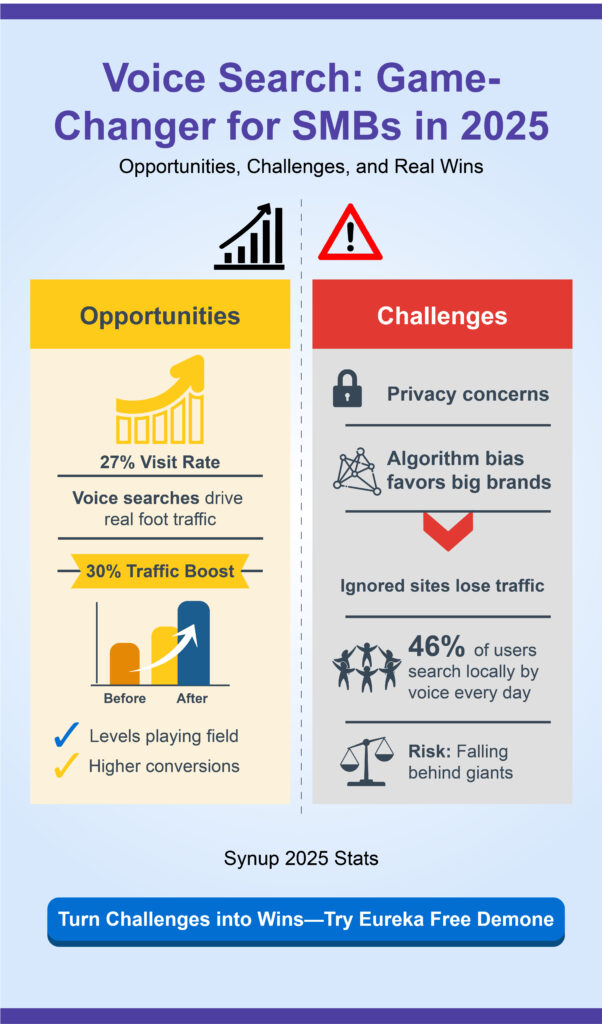
But it’s not all smooth sailing. Challenges include algorithm shifts—Google’s updates favor concise, answer-focused content, leaving wordy pages behind. Privacy worries deter some users, and if your data isn’t structured right, you’re invisible. Too many businesses get stuck with inconsistent listings across platforms, confusing assistants. Biases in AI can skew results, favoring large brands unless you optimize effectively.
Let’s look at examples. Take a hypothetical local bakery: Without voice optimization, it misses “gluten-free bakery near me” queries. But by claiming their Google Business Profile, adding schema markup, and crafting content around questions like “What’s the best time to get fresh croissants?”, they dominate. Real-world wins echo this—a Synup study of 2025 voice search data shows that optimized SMBs experience 3.5x more local engagement. For e-commerce SMBs, voice commerce is a goldmine; users buy via assistants, preferring sites with seamless mobile experiences.
The risks? Falling behind. Suppose your site isn’t mobile-first or doesn’t use natural language, an traffic declines. But flip it: Voice levels the playing field. SMBs can outrank giants with targeted, local SEO. No massive ad spends needed—just strategic tweaks. In my experience, the biggest hurdle is mindset—many think it’s too techy, but it’s not. With tools like Eureka Content Engine, you automate content updates, ensuring your site speaks the language of voice search. The impact? Sustainable growth, better ROI, and customers finding you effortlessly.
Best Practices for Voice Search Optimization
Alright, let’s get practical. Voice search optimization starts with keywords, but not the short ones you’re used to. Voice queries are 3-4 times longer, full of questions and qualifiers. Tools like SEMrush or Ahrefs help unearth these—think “How do I find affordable plumbing services in Chicago after hours?” Target long-tail phrases that match how people talk.
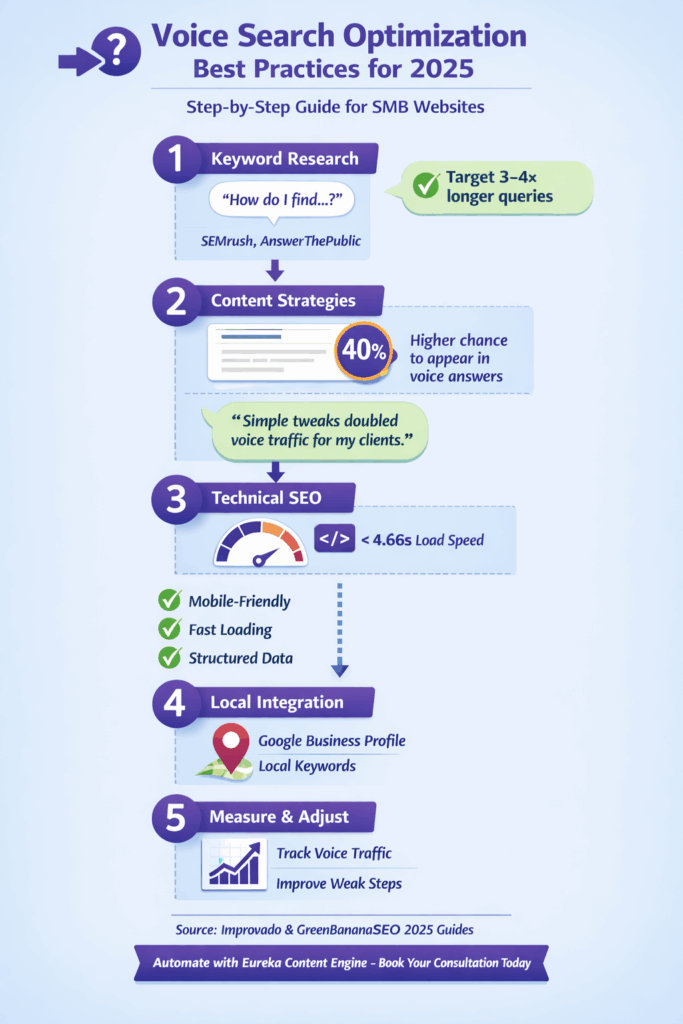
Content is king here. Aim for featured snippets, which power 40% of voice responses. Structure pages with FAQs, how-tos, and bullet points. Write naturally: “If you’re wondering about our hours, we’re open from 9 a.m. to 6 p.m. daily.” This grabs the “position zero” spot. From Improvado’s 2025 strategies, conversational content boosts rankings by 20%. Anecdote time: I once revamped a client’s blog with question-based posts, and their website traffic doubled in months.
Technical SEO is non-negotiable. Go mobile-first—Google prioritizes it. Ensure pages load in under 4.6 seconds; use tools such as PageSpeed Insights. Schema markup is your best friend—add it to your business, events, or products to help search assistants understand your data. For local SEO, update your Google Business Profile with accurate NAP (name, address, phone), photos, and reviews. Optimize for “near me” by including location-specific pages.
UX matters too. Clear headings, short paragraphs, and readable fonts make content voice-friendly. Integrate with assistants—test how your site sounds when read aloud. Measure success with Google Analytics: Track organic traffic from voice (look for query patterns), conversion rates, and snippet appearances. Adjust iteratively—maybe add more local keywords if traffic’s low.
For SMBs, affordability is key. Don’t overhaul everything; start small. Use free tools like Google’s Structured Data Testing Tool. Or, leverage AI like our Eureka Content Engine—it scans your site, suggests voice-optimized tweaks, and even generates content. Challenges? Keeping up with updates is essential, and subscribing to SEO newsletters is a helpful way to stay current. Pro tip: Multilingual optimization—add translated FAQs for broader reach. Done right, these practices turn voice search into a growth engine.
Tools and Future-Proofing Your Strategy
Equipping yourself with the right tools makes optimization a breeze. Start with the basics: Google Search Console for insights and AnswerThePublic for query ideas. For advanced, AI platforms shine. Our Eureka Content Engine at DM Digital automates keyword discovery, content creation, and performance tracking, tailored for SMBs seeking efficiency.
Looking ahead, watch for voice in AR/VR, where searches become immersive. Privacy-first designs will rise, with opt-in data sharing. Integrate emerging technologies, such as 5G, to enable faster load times. Future-proof by staying agile—regular audits keep you ahead.
At DM Digital, we deliver these wins at SMB prices. Think streamlined optimization without the agency bloat.
Conclusion
Voice search optimization isn’t overwhelming—it’s about aligning with how customers communicate. In 2025, embracing it drives visibility, traffic, and growth for SMBs. Start with audits, implement these strategies, and watch your site thrive.